Wednesday, May 18, 2011

Tagore : a romantic ?

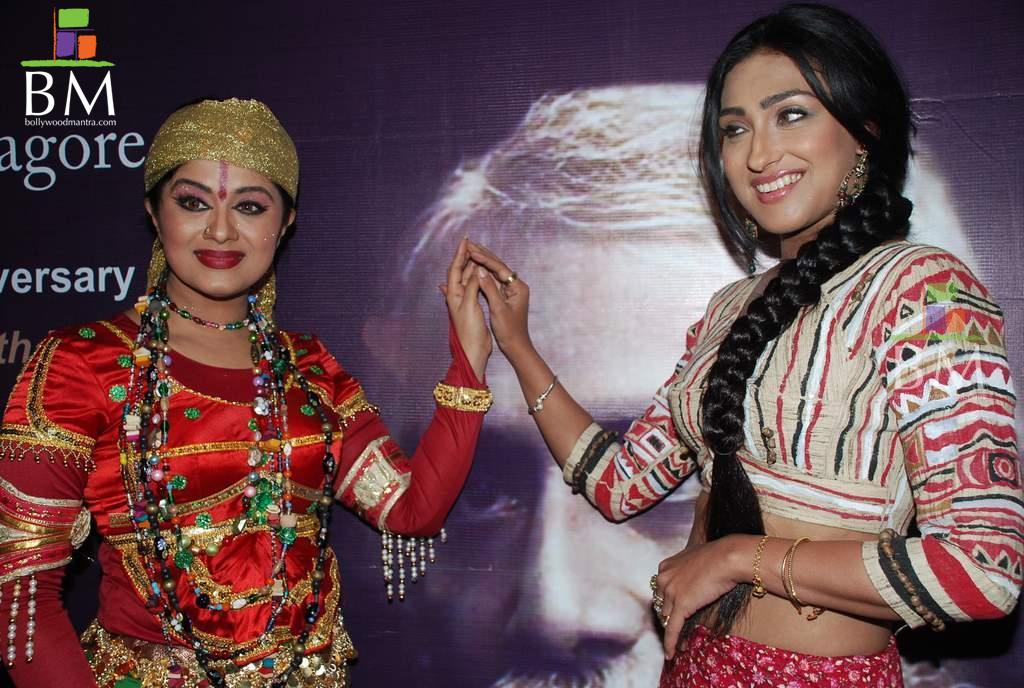
Danseuse Sudha Chandran and renowned Bengali actress Rituparna Sengupta in a recent event to mark the 150th birth anniversary of poet Rabindranath Tagore.

Interview with the great Bengali film-maker of yesteryears, the mercurial
Ritwik Ghatak
(Excerpted from the book Ritwik Ghatak On cinema.) :

Tagore music (Rabindra Sangeet) has an important functional role in most of your films. Could you explain your affinity to Rabindranath Tagore ?

I cannot speak without him. That man has culled all my feelings long before my birth. He has understood what I am.

In spite of the considerable influence of Rabindranath Tagore on you, we find that there is a qualitative difference between the works of Tagore and your films. Don't you think that he was excessively romantic ?

Romantic ! What do you know about him ? Rabindranath is not a romantic, his is a completely variegated affair. He is the performing monkey of Bengali literature. And you call him a romantic ? Have you read Chaturanga ? He is a mystic, agnotic, everything. He was also a great rogue and a great one for using vile language. He also wrote in the language used by street urchins. So do not try to sidetrack him as a romantic. Read the full range of the man's work. The structure of his writings is extremely tight. He is, as I said before, the performing monkey of Bengali literature. You must have seen the toy which has a ladder and a small monkey on the top. When you hold this toy upright the monkey rolls down. When inverted it slides down again. Rabindranath is like this toy monkey.

He can get to the top, step by step, and climb upside down as well. So, it is a great blunder to label him a romantic. There are some people who want to sell Rabindranath, and that is why you have this image of him impressed on your minds. You people have not read Rabindranath. You are yet to know of his anger. From the lowest rung of society to the highest he spared none. You can call me rogue, a rascal, but he was a greater one. Maybe he knew more four-letter words than I do. Do not have a distorted notion about him.

book : Rows And Rows of Fences - Ritwik Ghatak on cinema.

Thursday, April 28, 2011

Haiku on celluloid :

the films of Yasujiro Ozu

Friday Review interview with Donald Richie :
When did your interest in Japanese cinema begin ?

Ever since I went to Japan in 1947, I have been watching Japanese films. Even before I had met Kurosawa and Ozu in person, I was well-acquinted with Japanese cinema. I was then the film critic of the newspaper "Stars and Stripes". After the war, I joined "Japan Times". By then , I had fallen deeply in love with Japan. Moreover, I was not much interested in returning to Ohio, my homeland for several reasons.

In 1968, I returned to the U.S to join the New York Museum of Modern Art as film curator. Six years later, I flew back to Japan. I like the Japanese. They are orthodox as well as progressive.
I took only two months to write my book on Kurosawa. I stayed at the Hot Spring Resort at Kyosho in southern Japan to work on it. It took me much longer to finish my book on Ozu. I admired Kurosawa, but loved Ozu. It is difficult to write about someone or something you love. Your emotions stand in the way of your intellectual evaluation.

Ozu himself had believed that his subjects were too abstruce for the West to follow ....

True. Ozu had once said that. But on another occasion, he had told his cameraman that foreigners will one day rave about his style.
Why did the Japanese like Ozu ? Because they could see themselves in Ozu's films. Stylistically, he was unparalleled. I took Satyajit Ray for a screening of Ozu's "Tokyo Story" in Japan. I heard Ray sobbing as the reels rolled on.

Ozu has been a great influence on film makers in several countries. He has inspired some Kerala film makers. I am currently compiling a package, titled "Ozu's children", consisting of the works of such film makers as Jim Jarmusch and Hou Hsiao-Hsien, who had been profoundly influenced by Ozu.
A still from Yasujiro Ozu last movie An Autumn Afternoon (1962)

Had not Ozu, for whom oriental culture was as precious as his breath, been little incomprehensible for the westerner ?


So had been the belief. But I have proved that it is not so. My book shows how much I have understood Ozu. Infact, foreigners understand Ozu better than many young Japanese of today
do.

Compared with Ozu, Kurosawa was less popular in Japan....

Ozu was quintessentially Japanese, so people liked him. Kurosawa was also a genius.

I first met him in 1947. He was then shooting "Drunken Angel". Once I was with himon the sets. He was fiddling with a faulty pen. Yet, he would not give that upand use a new one.
Toshiro Mifune (actor in most of Kurosawa films), who was with us, called me aside and said, " I am that pen. See how carefully and painstakingly he works on it."

What is your assessment of contemporary Japanese cinema ? (as in 1998)
There are a few good serious film makers, who include Mitsuo Yanagimachi("Fire Festival") , Hirokazu Kore-Eda ("AfterLife") and Makoto Shinozaki ("Okaeri"). But they are quite a small group. People seem to prefer Hollywood movies to native ones.

But during the time of Ozu or Mizoguchi, there was an audience for serious cinema....

Ozu and Mizoguchi belong to the pre-TV era. Cinema was then the sole means of entertainment. They lapped up the movies and thus production companies ran profitably. As the money was coming, the companies gave an Ozu or Mizoguchi a carte blanche.

courtesy : Friday Review - The Hindu Daily 1998.

Tuesday, April 12, 2011

Satyajit Ray & Akira Kurosawa

Two great film makers of the 20th century, Akira Kurosawa and Satyajit Ray meets at a Chinese restaurant in Tokyo - Extracts from the book Our Films Their Films by Satyajit Ray.

Like Ray, Kurosawa was also an accomplished artist who designed his own posters & story-boards.

As it turned out, the venue for the meeting was a Chinese restaurant in a quiet back-street of Tokyo.
'A favourite of Kurosawa's' said Mrs Kawakita, my hostess and a close friend of the director. Atleast one could face the gastronomic hazards with more confidence here.
Kurosawa turned out to be that rarity - a tall Japanese. He also had a stoop, with an appropriate humility to go with it, kindly eyes which a ready smile thinned into more slits, and a hushed and gentle tone of voice - all of which was in unexpected contrast to the ferocious image derived from his samurai films. But then, it's not unusual to find schizophrenics among people of theatrical profession, and I knew Kurosawa had samurai blood in him. I had visions of his unbridled other self, pitching into that scene of combat with all the controlled fury of a samurai himself.

I started by talking of Seven Samurai, which turned out to be both his and my favourite amongst his films. 'It needs long and hard training to be a film samurai' he said. 'There was so much about the samurai that was stylised - his ride, his run, the way he wielded the sword. A samurai would never be hunched over his saddle when charging. He would stand straight up with feet firmly on the stirrups and knees pressed tight against the flanks of the horse. His body would not be perpendicular, but leaning forward at an angle to prevent being thrown backwards by the force of the charge.'

Kurosawa rose from his chair to demonstrate the stance of the
charging samurai.

'And about the sword - it wouldn't cut at all if you only hacked with it. You would have to combine' (more demonstration here) 'a backing motion with a slicing motion. And when the samurai runs, his head shouldn't bob up and down with his footsteps. The effect should be like a swift floating. In other words, the head shouldn't trace a wavy curve, but a straight line'.
Rai and Samurai...Chips of the same block, Satyajit Ray & Akira Kurosawa during the later's visit to Delhi in the 70s.

A stickler for historical accuracy, Kurosawa in his period films, makes his actors put on period costumes obtained from museums.

'But you know where the snag is' he said with a twinkle in his eye
s. 'The Japanese as a whole have grown smaller over the last five or six hundred years. It is difficult to find actors large enough for these costumes to fit'.

I asked if he had any more samurai films in mind.

'None' he said. 'And I doubt if I could ever make another one'.

'Why not ? '

'Because there's such a dearth of horses now. You see, most of the horses used in films came from farms. But now farm-work has been machinised, and horses are bred only for racing'.

I heard that Kurosawa had been signed up by the American producer Joe Levine to direct a film in the USA. The news intrigued me, because this would be the first instance of an Asian director with only a rudimentary knowledge of English making an English-language film in the States.

'I had a story in mind' said Kurosawa. 'I had saved up a clipping from an American newspaper which described how a goods train went tearing through Chicago at eighty miles an hour with three men on board but no one at the control. For some unaccountable reason, the driver had jumped off and killed himself. The train as well as the passengers were ultimately saved, and the film will show how'.

But there were snags. Kurosawa had stipulated that he would work with his own Japanese crew consisting of some twenty technicians. Producer Levine's drastic rerms permitted only one non-English speaking assistant. The fact that Kurosawa had to concede could be indicative of either his great urge to film the story at any cost, or of the alarming situation of the serious film maker in Japan. What is true of Kurosawa is also true of Ichikawa, Kobayashi and Shindo.

However, a truly gifted film maker - as has often been proved in the history of the cinema - can rise above his circumstances; so that one can look forward to the The Runaway Train - if it ever gets made - with all the pleasurable anticipation of an authentic Japanese Kurosawa. Let us hope that a charging train will prove just as inspiring as a charging samurai.

chapter: Tokyo, Kyoto and Kurosawa - 1967
book : Our Films Their Films [a compilation of Ray's articles & essays on cinema] authour : Satyajit Ray

Friday, March 25, 2011

The Oscars

BEST PICTURE
127 Hours
Black Swan
The Fighter
Inception
The Kids Are All Right
The King’s Speech
The Social Network
Toy Story 3
True Grit
Winter’s Bone

BEST ACTOR
Javier Bardem, Biutiful
Jeff Bridges, True Grit
Jesse Eisenberg, The Social Network
Colin Firth, The King’s Speech
James Franco, 127 Hours

BEST ACTRESS
Annette Bening, The Kids Are All Right
Nicole Kidman, Rabbit Hole
Jennifer Lawrence, Winter’s Bone
Natalie Portman, Black Swan
Michelle Williams, Blue Valentine

BEST DIRECTOR
Darren Aronofsky, Black Swan
Joel & Ethan Coen, True Grit
David Fincher, The Social Network
Tom Hooper, The King’s Speech
David O. Russell, The Fighter

BEST EDITING
127 Hours, Jon Harris
Black Swan, Andrew Weisblum
The Fighter, Pamela Martin
The King’s Speech, Tariq Anwar
The Social Network, Angus Wall and Kirk Baxter

BEST ORIGINAL SCORE

127 Hours, A.R. Rahman
How to Train Your Dragon, John Powell
Inception, Hans Zimmer
The King’s Speech, Alexandre Desplat
The Social Network, Trent Reznor and Atticus Ross

BEST SONG
“Coming Home,” Country Strong, Tom Douglas, Troy Verges and Hillary Lindsey
“I See the Light,” Tangled, Alan Menken, Glenn Slater
“If I Rise,” 127 Hours, A.R. Rahman, Dido, Rollo Armstrong
“We Belong Together,” Toy Story 3, Randy Newman

BEST SUPPORTING ACTOR
Christian Bale, The Fighter
BEST SUPPORTING ACTRESS
Melissa Leo, The Fighter

BEST ORIGINAL SCREENPLAY
The King’s Speech, Screenplay by David Seidler

BEST ADAPTED SCREENPLAY
The Social Network, Screenplay by Aaron Sorkin
BEST ART DIRECTION
Alice
in Wonderland, Robert Stromberg, Karen O’Hara
BEST COSTUME DESIGN

Alice
in Wonderland, Colleen Atwood

BEST MAKEUP
The Wolfman, Rick Baker and Dave Elsey

BEST SOUND EDITING
Inception, Richard King
BEST SOUND MIXING
Inception, Lora Hirschberg, Gary A. Rizzo, and Ed Novick
BEST ANIMATED FILM

Toy Story 3

BEST ANIMATED SHORT

The Lost Thing, Shaun Tan and Andrew Ruhemann

BEST VISUAL EFFECTS
Inception, Paul Franklin, Chris Corbould, Andrew Lockley and Peter Bebb
BEST DOCUMENTARY
Inside Job, Charles Ferguson and Audrey Marrs
BEST LIVE-ACTION SHORT
God of Love, Luke Matheny
BEST DOCUMENTARY SHORT
Strangers No More, Karen Goodman and Kirk Simon

BEST FOREIGN LANGUAGE FILM
In a Better World (Denmark)

Friday, February 25, 2011

Bollywood : ripe for a revolution ?


In his recent trip to India, the Russian President Dimitri Medvedev took time-off to meet the bigwigs in Bollywood and called for a closer co-operation between Russia and Bollywood. Sharing the podium with Bollywood superstar Shahrukh Khan, President Medvedev even expressed his admiration for Bollywood song and dances. Last November, U.S President Barack Obama too came to Mumbai which has resulted in more joint-ventures between Hollywood and Bollywood.

While the local-media went ga-ga over this wooing of Bollywood by world leaders, the average movie-goer appears to be less enthusiastic. They are wondering how these joint-ventures could bring any visible change in the quality of Bollywood pot-boilers. They are already sick and tired of the 'escapist-entertainment' churned out by Bollywood. For a record, all the much hyped big-banner movies of the previous year - despite their agressive publicity campaign - have flopped. On the other hand, small-budget indie-movies, which deals with real life issues - targeting the middle-class/multiplex crowd - have done brisk business.

In any case , it's a wise move by President Medvedev to court superstar Shahrukh Khan - Bollywood's most talented and popular actors. He is an original actor with a solid theatre-background ( like most Hollywood actors) which enabled him to develop his own style, technique and confidence. Shahrukh Khan is also one of the few actors of Bollywood who is not part of any star-dynasty. But he also made his debut long ago (in the early 90s) much before the star-dynasties began to monopolise the film-industry. In the past decade (2000s), many original and talented actors like Shahrukh Khan have made their debut and where are they now ? Despite winning popular and critical acclaim, these newcomers have vanished (or banished ?) without a trace. In contrast, the good-for-nothing star-kids - in spite of their repeated failure and incompetence - are still clinging to their inherited 'stardom'. As a critique has put it, Bollywood have long ceased to be a film-making industry - infact it's now a 'star-producing' industry !


Once upon a time in Russia (and also in China and other parts of the world), Bollywood movies - or Hindi movies as it is then known - were very popular, thanks to the pioneering efforts of stalwarts like Raj Kapoor, Guru Dutt, Mehboob Khan, V.Shantaram, Kamal Amrohi, Bimal Roy etc. Their classics besides entertaining, also dealt with the issues concerning the masses. The current Bollywood , living in their 'castles' have not only lost touch with the common man, they now started looking down upon them. Most Bollywood movies now are either poor parody of earlier classics or a scene-to-scene, shot-to-shot copy of major Hollywood movies.


The present decadent state of Bollywood - with its 'Kings','queens' and 'king-makers'- resembles the Tsarist Russia of 19th century. It's indeed a shame that the largest film-industry in the largest democracy still functions like a bunch of medieval artisants - closely guarding their trade .The scribes of local-media (esp. the beneficiaries of a corrupted system) may claim the contrary, with phrases like - 'this is the most exciting times in the history of our film-industry'. But the average movie-goer cannot be kept under dark for long.
Unless merit and creativity is not given its due recognition, all the boasting and bragging about 'Bollywood becoming the next Hollywood' will always remain a day-dream.

Sunday, February 13, 2011

Fairuz - the legend


singer : Fairuz


title : A Hadir il-Bosta (1999)

album : The Legendary Fairuz

trivia : This's a very popular Fairuz song. I first heard it while
at Dubai in 1999 - thanks to the friendly Syrian shop-keeper.
Fairuz sings about her crush on a man called Aliya and she
praises his beautiful eyes.

Friday, February 11, 2011

Kahlil Gibran

Painting by Kahlil Gibran

Song of Beauty

I am the guide of love
I am wine of the spirit
I am food to the heart.


I am a rose ;
I open my heart at daybreak; a maiden plucks me and kisses me
and puts me to her breast.


I am the abode of happiness
And the source of joy.
I am the beginning of repose.


I am a gentle smile on the lips of a maid ;
Youth beholds me, his toil is forgotten, and his life
becomes a stage for sweet dreams.


I am the poet's imagination
And the artist's guide.
I am teacher to the music-maker.
I am the glance in the eye of a child
Behold by a tender mother.
Before it does she pray and glorify God.


I appeared to Adam in Eve's image
And enslaved him.
I was revealed to Solomon in his beloved, and made
him poet and sage.
I smiled on Helen,
And Troy was destroyed ;
I crowned Cleopatra, and peace conquered the Nile.


I am as Destiny;
In this day I build,
On the morrow destroy.
I am God,
I quicken and make dead.


I am lighter than a sigh from the violet flower,
And mightier than the tempest.
I am a Truth, O people, yea , a Truth .

from the book A Tear And A Smile by Kahlil Gibran