Wednesday, August 31, 2011

ABBA


Hasta mañana - chords & lyrics
intro: F Am B# C

VERSE:
(F)Where is the (Am)spring and the (B#)summer (C)
(F)that once was (Am)yours and mine.(B#) (D7)
(Gm)Where did it go, (B#)I just don't know,
(Gm)but still my love for you will (C)live forever.

CHORUS:
(F)Hasta mañana 'till we (Am)meet again,
(Dm)don't know where, don't know (Gm)when.
(Gm)Darling our love was much too (C)strong to die,
(Gm)we'll find a way to face a (C)new tomorrow.
(F)Hasta mañana say we'll (Am)meet again,
(D7)I can't do without (Gm)you.
(B#)Time to forget, send me a letter,
(Bm#)Say you forgive, the sooner the better.
(F)Hasta (D7)mañana baby, (Gm)hasta (C)mañana until then. (F)


Wednesday, August 3, 2011

R.D Burman


song :
Shono Ei To Somoy (1986)


album : Modern Bengali Songs of R.D Burman

singer/composer : R.D Burman

Trivia : R.D Burman made this song during the twilight of his career. But it is difficult to believe !The song has such energy and passion typical of the 80s, as if a teenage-band has created it! That speaks much about R.D.B - always well ahead of his times.

Wednesday, July 27, 2011

Amy Winehouse joins Club 27

Here goes another meteor ! .... Not only in her looks, in her real life too, Amy Winehouse lived very much in the 'spirits' of 60s & 70s.

I am not a fan of her nor I am familiar with her music. From the few tracks I have so far heard here and there, Amy Winehouse is a singer & song-writer of considerable talent. But I always liked her for being different, with her devil-may-care attitude. At a time when even an occational bath-room singer can become an 'idol' or an 'icon' by gate-crashing into some venues of reality TV-shows, and claiming thousands of fans & followers instantly, Amy Winehouse was a throw-back to the bygone era. An era where art and creativity were pursued with unique craze & passion, even leading to self-destruction.

Amy Winehouse too lived on the edge, choosing a lonely, risky and self-destructive path. Music world has lost a great talent. May her soul rest in peace.


All members of Forever 27club (from left): Jimi Hendrix,Kurt Cobain(Nirvana), AmyWinehouse, Janis Joplin and my most favourite among them, Jim Morrison.


Wednesday, June 29, 2011

M.F Hussain (1915-2011)

The world renowned artist M.F Hussain passed away on June 9th at the age of 95. The Mumbai-based painter has been living in exile for the past few years, in Dubai, Doha and finally in London.

M.F Hussain started off as a hoarding painter for movies in the 1940s. This product of prestigious J.J School of Arts went on to exhibit his works in Europe in 1950s which won him many accolades. In subsequent decades, he became the most valued and sought-after painter of modern India. Also known as 'India's Picasso', no drawing-room of the elite was complete with out an 'M.F Hussain'. Till the 1980s, he was largerly known among the art-lovers,the elite and intelligentsia.

M.F Hussain and his muse , the renowned Hindi movie-star Madhuri Dixit during the 90s. Both had great respect for each other.

The advent of 1990s saw M.F Hussain making news for all the wrong reasons. With the rise of Indian extremism, where each and every issue has been viewed through a communal angle, M.F Hussain became their favourite punching-bag. The centre of the controversy were his few paintings, he did decades ago, now misinterpreted as ' hurting religious sentiments'. The shows of his paintings were attacked and destroyed, numerous law suits were filed against him and there were even threat to his life. In such an atmosphere of blind-hate, even a genuis like Albert Einstein had to flee for life. M.F Hussain too fled from his country for good.
M.F Hussain made foray into film-making, directing two avant-garde movies . Gaja Gamini (2000) starred the legend herself : Madhuri Dixit.

Even during the times of persecution and intimidation, M.F Hussain silently continued his work and let his brush do all the talking. Infact those who were familiar with his works did not doubt his integrity and the artistic circles of India stood firmly behind him. He continued to produce many classic works even during the twilight of his career and made foray into the movies, directing 'Gaja Gamini'(2000) and 'Meenaxi: A Tale of Three Cities' (2004). He accepted Qatari citizenship but his home-country, especially his home-state Maharashtra where he spent most of his life, was always dear to him.
The second and final movie he made - Meenaxi : Tale of Three Cities (2004) was also in the genre of avant-garde.

The M.F Hussain episode is a example for those who spread hate and intolerance to advance their own causes. As the old saying goes, 'a lie has no antique value and truth will prevail sooner or later'. About a 100-years ago, Hitler unleashed a campaign against Jews based on some false allegations and propoganda. Now where is Hitler and where are Jews ? The former has been dumbed into the dust-bin of history, while the later became powerfull and influencial group in the world.

The great master's long eventfull creative life came to an end. But his art-works will continue to tell many tales in the years, decades and centuries to come. As M.F Hussain said in a recent TV interview : "Only the titles of the paintings were told, the real story takes a life time".

Frontline magazine has issued special features in their latest issue remembering the great M.F Hussain, which can be seen here:
http://www.frontlineonnet.com/fl2813/fl281300.htm

Friday, June 10, 2011

Asian challenge

China's Li Na becomes the first Asian -male or female - to win a Grand slam title. She defeated the defending champion Francesca Shiavone 6-4,7-6(7-0) to win the French Open. Early this year Li Na came close to winning this distinction in the Australian Open but Kim Clijsters dashed her hopes. It is remarkable that Li Na's top form has not affected by the change of surface - from hard-court to clay-court.
But is Li Na the first ethnic Chinese to win the Grand slam ? I doubt it. If my assumption is right, that distinction goes to Michael Chang of U.S who won the French Open way back in 1989.
Mean while, Sania Mirza came close to become the first Indian woman to win a major doubles title. Infact, she was having a great run this year in the doubles partnering Elena Vesnina of Russia. So their presence in the finals hardly came as a surprise. But in the final they were beaten by unseeded Czech pair Andrea Hlavackova and Lucie Hradecka in straight sets 6-4,6-3. Anyway, best wishes for the rest of season, including Wimbledon and U.S Open.

Wednesday, May 18, 2011

Tagore : a romantic ?

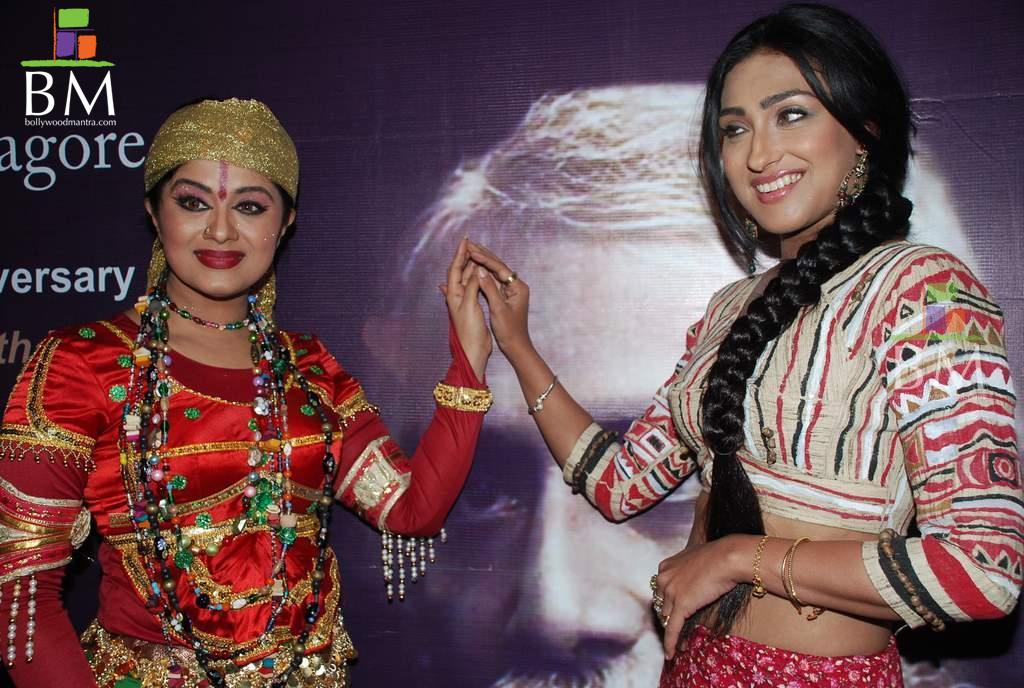
Danseuse Sudha Chandran and renowned Bengali actress Rituparna Sengupta in a recent event to mark the 150th birth anniversary of poet Rabindranath Tagore.

Interview with the great Bengali film-maker of yesteryears, the mercurial
Ritwik Ghatak
(Excerpted from the book Ritwik Ghatak On cinema.) :

Tagore music (Rabindra Sangeet) has an important functional role in most of your films. Could you explain your affinity to Rabindranath Tagore ?

I cannot speak without him. That man has culled all my feelings long before my birth. He has understood what I am.

In spite of the considerable influence of Rabindranath Tagore on you, we find that there is a qualitative difference between the works of Tagore and your films. Don't you think that he was excessively romantic ?

Romantic ! What do you know about him ? Rabindranath is not a romantic, his is a completely variegated affair. He is the performing monkey of Bengali literature. And you call him a romantic ? Have you read Chaturanga ? He is a mystic, agnotic, everything. He was also a great rogue and a great one for using vile language. He also wrote in the language used by street urchins. So do not try to sidetrack him as a romantic. Read the full range of the man's work. The structure of his writings is extremely tight. He is, as I said before, the performing monkey of Bengali literature. You must have seen the toy which has a ladder and a small monkey on the top. When you hold this toy upright the monkey rolls down. When inverted it slides down again. Rabindranath is like this toy monkey.

He can get to the top, step by step, and climb upside down as well. So, it is a great blunder to label him a romantic. There are some people who want to sell Rabindranath, and that is why you have this image of him impressed on your minds. You people have not read Rabindranath. You are yet to know of his anger. From the lowest rung of society to the highest he spared none. You can call me rogue, a rascal, but he was a greater one. Maybe he knew more four-letter words than I do. Do not have a distorted notion about him.

book : Rows And Rows of Fences - Ritwik Ghatak on cinema.

Thursday, April 28, 2011

Haiku on celluloid :

the films of Yasujiro Ozu

Friday Review interview with Donald Richie :
When did your interest in Japanese cinema begin ?

Ever since I went to Japan in 1947, I have been watching Japanese films. Even before I had met Kurosawa and Ozu in person, I was well-acquinted with Japanese cinema. I was then the film critic of the newspaper "Stars and Stripes". After the war, I joined "Japan Times". By then , I had fallen deeply in love with Japan. Moreover, I was not much interested in returning to Ohio, my homeland for several reasons.

In 1968, I returned to the U.S to join the New York Museum of Modern Art as film curator. Six years later, I flew back to Japan. I like the Japanese. They are orthodox as well as progressive.
I took only two months to write my book on Kurosawa. I stayed at the Hot Spring Resort at Kyosho in southern Japan to work on it. It took me much longer to finish my book on Ozu. I admired Kurosawa, but loved Ozu. It is difficult to write about someone or something you love. Your emotions stand in the way of your intellectual evaluation.

Ozu himself had believed that his subjects were too abstruce for the West to follow ....

True. Ozu had once said that. But on another occasion, he had told his cameraman that foreigners will one day rave about his style.
Why did the Japanese like Ozu ? Because they could see themselves in Ozu's films. Stylistically, he was unparalleled. I took Satyajit Ray for a screening of Ozu's "Tokyo Story" in Japan. I heard Ray sobbing as the reels rolled on.

Ozu has been a great influence on film makers in several countries. He has inspired some Kerala film makers. I am currently compiling a package, titled "Ozu's children", consisting of the works of such film makers as Jim Jarmusch and Hou Hsiao-Hsien, who had been profoundly influenced by Ozu.
A still from Yasujiro Ozu last movie An Autumn Afternoon (1962)

Had not Ozu, for whom oriental culture was as precious as his breath, been little incomprehensible for the westerner ?


So had been the belief. But I have proved that it is not so. My book shows how much I have understood Ozu. Infact, foreigners understand Ozu better than many young Japanese of today
do.

Compared with Ozu, Kurosawa was less popular in Japan....

Ozu was quintessentially Japanese, so people liked him. Kurosawa was also a genius.

I first met him in 1947. He was then shooting "Drunken Angel". Once I was with himon the sets. He was fiddling with a faulty pen. Yet, he would not give that upand use a new one.
Toshiro Mifune (actor in most of Kurosawa films), who was with us, called me aside and said, " I am that pen. See how carefully and painstakingly he works on it."

What is your assessment of contemporary Japanese cinema ? (as in 1998)
There are a few good serious film makers, who include Mitsuo Yanagimachi("Fire Festival") , Hirokazu Kore-Eda ("AfterLife") and Makoto Shinozaki ("Okaeri"). But they are quite a small group. People seem to prefer Hollywood movies to native ones.

But during the time of Ozu or Mizoguchi, there was an audience for serious cinema....

Ozu and Mizoguchi belong to the pre-TV era. Cinema was then the sole means of entertainment. They lapped up the movies and thus production companies ran profitably. As the money was coming, the companies gave an Ozu or Mizoguchi a carte blanche.

courtesy : Friday Review - The Hindu Daily 1998.